
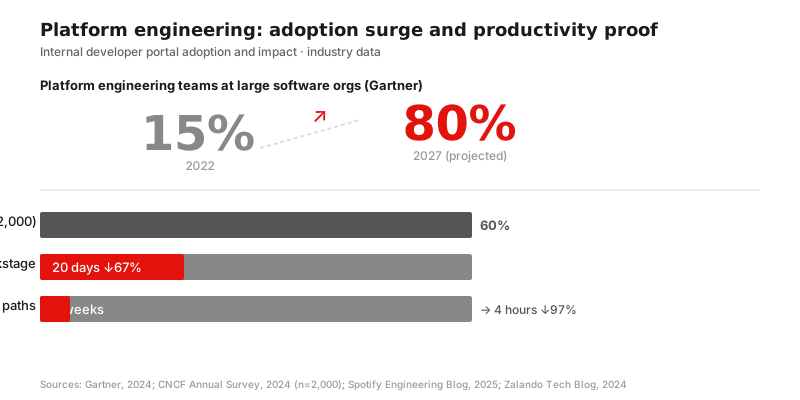
 Source: Gartner, 2024; CNCF Annual Survey, 2024; Spotify Engineering Blog, 2025
Platform engineering — the discipline of building internal toolchains and self-service infrastructure for development teams — has moved from conference buzzword to organisational imperative. Gartner predicts that by 2027, 80% of large software engineering organisations will have established platform engineering teams, up from fewer than 15% in 2022. The shift reflects a hard-won lesson: giving every team unfettered access to raw cloud primitives does not scale.
The problem with infinite choice
The promise of cloud-native development was liberation. Containers, Kubernetes, serverless functions, and infrastructure-as-code tools handed developers unprecedented power to provision and deploy. What followed was not the productivity revolution that vendor slide decks forecast but a proliferation of bespoke configurations, inconsistent security postures, and what Humanitec’s 2024 State of Platform Engineering report termed “the paradox of choice paralysis.”
The Cloud Native Computing Foundation’s (CNCF) 2024 survey of over 2,000 organisations found that the average enterprise manages 16 different developer tools across the software delivery lifecycle. Nearly 60% of respondents reported that developers spend more than 30% of their time on infrastructure tasks rather than writing application code. Cognitive load — the mental overhead of navigating tooling complexity — had become the silent tax on engineering velocity.
This is the environment that platform engineering addresses. Rather than expecting every team to assemble its own deployment pipeline, database provisioning workflow, and monitoring stack, platform teams build opinionated, self-service “golden paths” — pre-approved, well-documented routes from code commit to production deployment. The developer retains autonomy to deviate when necessary. The default, however, is paved.
The internal developer portal
At the centre of most platform engineering strategies sits an internal developer portal (IDP): a single interface through which developers discover services, provision infrastructure, trigger deployments, and consult documentation. The portal transforms scattered tribal knowledge into searchable, standardised, and governed information.
Spotify’s Backstage, open-sourced in 2020 and accepted as a CNCF incubating project in 2022, has become the reference implementation. Its software catalogue, scaffolding templates, and plugin architecture have attracted over 2,800 adopters by early 2026, according to the CNCF’s project metrics. Backstage succeeded not because it was the most polished product — early adopters often describe months of customisation before it delivers value — but because it codified what every scaling engineering organisation eventually needs: a single pane of glass for the developer experience.
Commercial alternatives have sharpened the market. Port, an Israeli startup, raised $33 million in Series A funding in 2024 and offers a no-code portal builder that reduces the implementation timeline from months to weeks. Cortex, acquired by a larger infrastructure vendor in 2025, focused on service maturity scorecards — measuring each team’s adherence to production readiness standards such as on-call coverage, documentation completeness, and dependency freshness. The common thread is that all three platforms treat developer experience as a product to be designed, measured, and iterated upon, rather than an afterthought.
Measuring what matters
The strongest evidence for platform engineering’s impact comes from organisations that have published before-and-after metrics. Spotify reported that Backstage reduced new-developer onboarding time from an average of 60 days to fewer than 20 — a 67% improvement that translates directly into revenue for a company hiring hundreds of engineers per year. Zalando, the European e-commerce group, published internal data showing that its platform team’s golden-path templates reduced time-to-first-deployment for new microservices from two weeks to under four hours.
These gains echo findings from the DORA (DevOps Research and Assessment) programme. The 2024 Accelerate State of DevOps Report found that organisations with well-implemented internal platforms were 2.4 times more likely to be classified as elite performers on DORA’s four key metrics: deployment frequency, lead time for changes, change failure rate, and mean time to recovery. The correlation held after controlling for organisation size, industry, and cloud maturity.
The economic argument is straightforward. McKinsey’s 2024 analysis of software developer productivity estimated that the average enterprise developer loses 20–30% of working time to “developer toil” — repetitive operational tasks that a well-designed platform could automate. For an organisation with 500 developers at a fully loaded cost of $200,000 each, eliminating even half of that toil represents $10–15 million in recovered annual capacity. Platform teams, typically staffed at 5–8% of total engineering headcount, represent a fraction of that figure.
The golden path is not a golden cage
Critics argue that platform engineering risks recreating the centralised IT bureaucracies that DevOps sought to dismantle. The concern is legitimate. A platform that mandates tooling choices without feedback loops, that prioritises governance over developer ergonomics, or that lacks clear escape hatches for teams with genuinely exceptional requirements will breed resentment and shadow infrastructure.
The most effective platform teams operate with a product mindset. They survey their internal customers, measure adoption rates and satisfaction scores, and treat low usage as a signal to improve — not a justification for mandates. Thoughtworks’ Technology Radar has consistently advocated for this approach, describing golden paths as “optional defaults with high gravitational pull” rather than enforced standards.
There is also the question of who builds the platform. The CNCF’s 2024 survey revealed that 40% of organisations attempting platform engineering lacked dedicated platform teams, instead assigning the work to existing DevOps or infrastructure engineers as a secondary responsibility. These part-time efforts correlated strongly with lower satisfaction scores and higher abandonment rates. Platform engineering, it turns out, requires the same product discipline as any other software product — dedicated ownership, user research, iterative delivery, and sustained investment.
Implications for engineering leadership
For organisations evaluating platform engineering, the pattern is now clear enough to act on. First, start with developer pain points rather than technology selection. The portal is a means, not an end. Second, staff the platform team as a product team: a product manager, dedicated engineers, and a clear mandate to serve internal customers. Third, instrument adoption. If developers are not using the golden path voluntarily, the path needs repaving. As explored in a previous analysis of AI-assisted development’s hidden costs, tooling that promises productivity gains without accounting for developer behaviour and cognitive load often fails to deliver lasting results.
The organisations that will benefit most are those already feeling the strain of scale — teams tripping over inconsistent deployment practices, security reviews bottlenecked by bespoke configurations, and new hires taking months to become productive. For them, platform engineering is not a trend to watch. It is infrastructure to build.
References
- Gartner, “Top Strategic Technology Trends for 2024: Platform Engineering”, Gartner, October 2023
- Cloud Native Computing Foundation, “CNCF Annual Survey 2024”, CNCF, 2024
- Humanitec, “State of Platform Engineering Report Vol. 3”, Humanitec, 2024
- DORA, “Accelerate State of DevOps Report 2024”, Google Cloud, 2024
- McKinsey & Company, “Unleashing Developer Productivity with Generative AI”, McKinsey Digital, 2024


Discussion