
Security debt behaves like financial debt with one important difference: the interest invoice often arrives as a breach. A vulnerability left unpatched this quarter rarely appears as an accounting entry. It reappears later as incident-response overtime, regulatory exposure, delayed releases, higher cyber-insurance premiums, and board meetings devoted to explaining why a known weakness was left in place. Cybersecurity Ventures projects that unmanaged security debt will cost organisations an average of $9 million annually by 2026. The figure is less a forecast than a warning about what happens when patching, asset visibility, and remediation capacity remain permanently undersupplied.
What makes the problem stubborn is that most leaders already understand the principle. They know that delaying remediation increases risk. Yet the operating model still treats vulnerability management as a discretionary clean-up task rather than a funded capability. The result is the same pattern seen across software delivery: structural underinvestment creates a backlog, the backlog normalises, and the cost of clearing it rises faster than the budget allocated to reduce it.
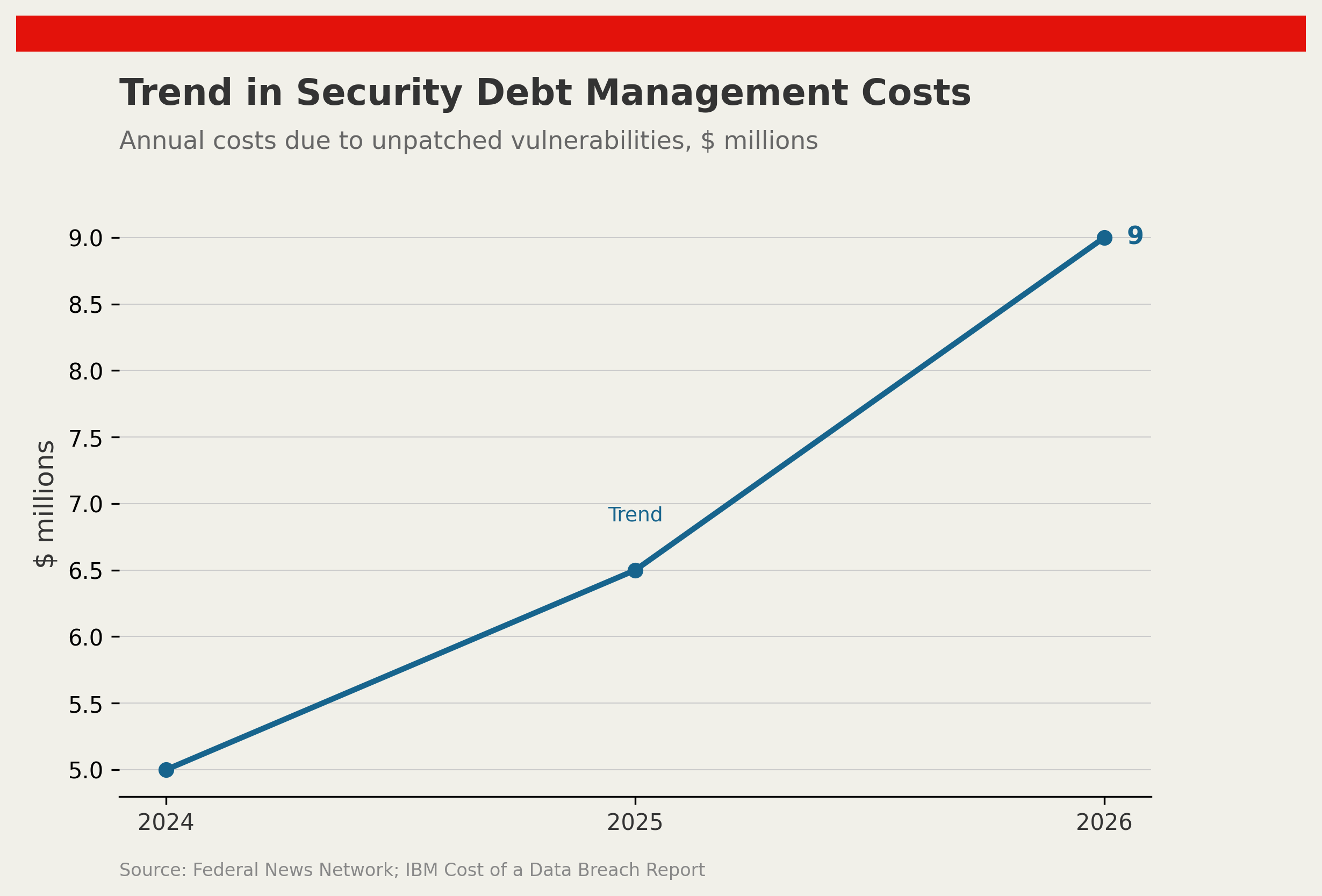 Source: Cybersecurity Ventures, 2026; IBM Cost of a Data Breach Report, 2025
The bill arrives after the breach
Unpatched vulnerabilities are a ticking time bomb, accounting for up to 60% of cyber breaches. Even as the average cost of a data breach reached $4.35 million in 2025, the urgency of addressing these vulnerabilities has not been matched by action within many companies. Analysts from the IBM Cost of a Data Breach Report affirm that these breaches are not merely costly incidents but symptomatic of deeper systemic issues within organisations’ approaches to cybersecurity.
Companies that delay patching critical vulnerabilities often see their potential breach costs rise by as much as 50%, according to FTI Consulting. This daunting increase demonstrates not only the latent financial risks but also the reactive approach many organisations have towards cybersecurity. Rather than proactively managing vulnerabilities, businesses frequently find themselves in a cycle of firefighting—addressing issues only after they escalate into breaches.
Why the debt keeps compounding
The charted rise from $5 million in 2024 to a projected $9 million in 2026 captures more than inflation in cyber tooling. It reflects the compounding mechanics of neglected exposure. The longer a backlog of critical findings remains unresolved, the more systems, suppliers, and business processes depend on insecure foundations. Security debt stops being a technical hygiene problem and becomes a drag on operating flexibility.
Addressing security debt is not just a technical challenge but a financial and managerial one. A majority, 60% of Chief Information Security Officers (CISOs), cite budget constraints as the primary hurdle in addressing security debt effectively. The McKinsey Cybersecurity Survey underscores this reality, highlighting how severely limited budgets inhibit the ability to undertake comprehensive vulnerability management.
These constraints lead organisations to spend an average of 10% more on security tools due to inadequate vulnerability management. Essentially, limited budgetary allocations force many companies into a reactive, rather than proactive, stance on cybersecurity, leaving them vulnerable to constant threats and the associated high costs. The irony is that many of these same organisations will still approve emergency spend after an incident because the post-breach invoice is politically unavoidable in a way that preventive investment rarely is.
Automation is not absolution
Despite the rising consensus on the escalating costs of security debt, a contrarian viewpoint suggests that strategic investments in security tools and automation could mitigate these projected costs significantly. Proponents argue that, when integrated with robust management practices, such investments could provide a more stable financial impact than expected, allowing organisations to maintain operational efficiency without succumbing to rising cybersecurity costs.
This view is partly right and often overstated. Tooling does help when it reduces detection latency, prioritises exploitable findings, and gives analysts better visibility into attack paths. But automation does not cancel the debt on its own. Even the strongest AI-driven threat-detection programmes still depend on disciplined patch management, asset inventories, exposure tracking, and leadership willing to fund remediation work that produces no immediate applause.
What leaders should fund first
The financial dynamics of security debt will continue to evolve as organisations strive to keep pace with a rapidly changing cyber threat landscape. The continuous increase in breach costs and security debt management expenses indicates a clear requirement for a strategic overhaul. Organisations must move towards integrating proactive measures into their cybersecurity frameworks.
A real-world example can be seen in the strategic approach taken by major financial institutions. These institutions have incorporated AI-driven threat detection tools, which not only identify potential breaches before they occur but also provide predictive insights that enable more effective resource allocation. These tools represent a forward-thinking strategy that organisations across sectors can emulate to balance their budgets against the need for robust security measures.
Furthermore, organisations adopting comprehensive cyber hygiene practices will be better positioned to manage security debt effectively. By revisiting their security policies, investing in remediation capacity, and keeping abreast of emerging threat landscapes, they ensure their investments in cybersecurity yield tangible returns. The key lies in transforming cybersecurity from a reactive to a proactive posture, ensuring robust defence mechanisms are in place long before threats materialise.
Ultimately, organisations that strategically invest in advanced security practices and tools today will safeguard their operations and finances against the increasing threat of cyber vulnerabilities tomorrow.
References
- Federal News Network, “Visibility is the Only Way to Fix the Public’s Growing Security Debt”, Federal News Network, 2026, Accessed online.
- IBM Cost of a Data Breach Report, “Data Breach Costs”, IBM, 2025, Accessed online.
- FTI Consulting, “2026: Make-or-Break Year for Economy”, FTI Consulting, 2026, Accessed online.
- McKinsey Cybersecurity Survey, “Cybersecurity 2026”, McKinsey, 2026, Accessed online.




Discussion