
DORA’s 2025 State of AI-Assisted Software Development report, based on data from 39,000 developers across 3,000 organisations, found that AI coding tools increased code throughput by 25% while decreasing developer satisfaction and code stability. METR’s independent study, published in July 2025, was blunter: experienced open-source developers using AI assistance completed tasks 19% slower than those working without it, once review and debugging time was included. The productivity narrative around AI coding tools is fracturing under empirical scrutiny.
The throughput illusion
GitHub reported in its 2025 Octoverse analysis that Copilot now generates over 55% of code on its platform — up from 46% a year earlier. Stack Overflow’s 2025 Developer Survey found 85% adoption among professional developers. The tools are ubiquitous. The question is whether ubiquity correlates with quality.
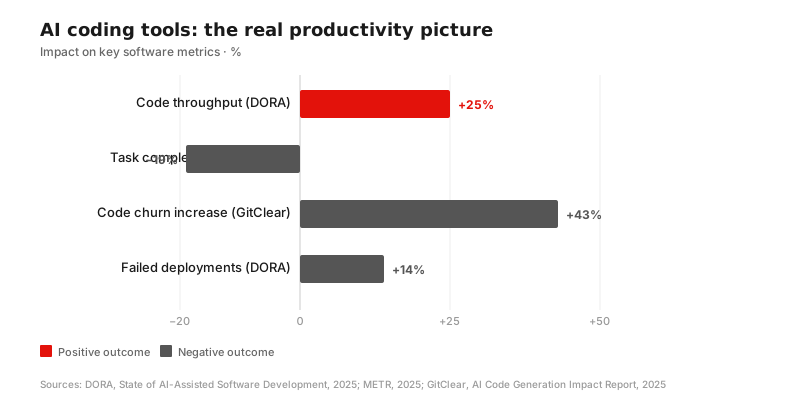 Source: DORA, 2025; METR, 2025; GitClear, 2025
DORA’s research suggests it does not. Teams using AI coding tools heavily showed higher deployment frequency but also experienced 14% more failed deployments and 8% longer recovery times. The code shipped faster. It also broke more often. GitClear’s longitudinal analysis of 250 million lines of code through 2025 reinforced this finding: code churn — the percentage rewritten within two weeks — rose 43% in AI-heavy repositories compared with pre-AI baselines.
The comprehension debt
The World Quality Report 2025-2026, published by OpenText (formerly Micro Focus) with Capgemini, surveyed 1,800 technology leaders and identified a pattern they termed “comprehension debt.” Junior developers using AI tools could produce syntactically correct code at speed but scored 22% lower on architectural reasoning assessments than their counterparts who coded without assistance. The code compiled. The developer had not learned.
Consider a mundane but consequential assignment: add retry logic around a payment-service client. A coding model can generate the wrapper, the backoff policy, and a neat set of unit tests in under a minute. What it cannot infer from a short prompt is which failures are safe to retry, how duplicate events are reconciled in the ledger, what audit trail finance requires, or how the queue behaves when a dependency returns a late success. The code looks finished precisely because the missing context is operational rather than syntactic. A junior developer can therefore ship something that passes review for style and still fails the business the first time a partial outage hits.
That is why AI-heavy code often arrives with hidden review work attached. The first draft is instant; the verification is not. Senior engineers know to interrogate generated code for edge cases, transaction boundaries, and observability gaps. Less experienced engineers are more likely to review for readability alone. The difference is not taste. It is whether the reviewer can see the system that exists outside the snippet. GitClear’s churn data suggests many teams discover those omissions only after merge, when supposedly finished code is rewritten in the first fortnight.
The honest productivity gain
Stripped of marketing, AI coding tools deliver a consistent 15-20% net productivity improvement for experienced engineers working on well-defined tasks, according to DORA’s adjusted measurements. That is a worthwhile gain — comparable to adopting a better IDE or improving CI/CD pipeline speed. It is not the 55% transformation that vendor metrics imply.
The organisations extracting genuine value therefore treat AI as a narrow accelerant. Boilerplate generation, test scaffolding, documentation drafts, schema transforms, and routine refactors are favourable use cases because the human can validate the output quickly and the maintenance burden is low. The gains disappear when teams use AI to bypass design. If a prompt has to smuggle in business rules, resilience requirements, security constraints, and organisational context, the cheaper path is usually to write the design first and the code second. This is less glamorous than the autonomous-coder narrative, but it aligns with the broader distinction between inspection and systemic quality explored in The quality confusion tax: when QA, QC and QE blur.
The crutch works when the patient knows how to walk without it. For everyone else, it substitutes speed for understanding — a trade that compounds in cost with every deployment. The most consequential question for engineering leadership is not whether to adopt AI tools — that debate is settled — but whether to invest equally in the developer learning that prevents those tools from becoming a substitute for competence.
The calibration challenge
Organisations that have navigated this tension successfully share a common approach: they treat AI tools as a calibration problem, not a deployment problem. The question is not which tools to enable but for whom, at what stage, and on which task types.
The pattern is visible in the published data. DORA’s adjusted gains are strongest on bounded tasks. METR’s slowdown appears when work requires deep understanding of an unfamiliar codebase. Stack Overflow’s survey suggests developers are using AI partly to avoid slower context-gathering activities such as documentation reading. Put differently: AI helps most when the task is local and hurts most when the task is systemic.
A more transferable version of that logic is to classify work into three bands. Green tasks — data mapping, unit-test scaffolding, repetitive API clients, log-query helpers — can be delegated aggressively because mistakes are cheap and easy to spot. Yellow tasks — business-logic changes in familiar services — merit AI assistance only when the engineer owns the module and can explain the change without the tool. Red tasks — authentication, billing, database migrations, incident fixes, anything with irreversible side effects — should default to human-first design and human-authored code, with AI limited to peripheral help such as draft tests or documentation. Most organisations do not need a policy on “AI coding” in the abstract. They need a task-level risk model.
According to the 2025 Stack Overflow Developer Survey, 62% of developers reported that AI tools had reduced the time they spent reading documentation — a troubling finding, since documentation reading is precisely how engineers build the contextual understanding that separates good AI output from bad. Speed gains that come at the cost of comprehension are not efficiency improvements. They are deferred liabilities, accumulating invisibly in codebases that developers no longer fully understand.
References
- DORA, “State of AI-Assisted Software Development 2025”, DORA/Google Cloud, September 2025
- METR, “Measuring the Impact of Early-2025 AI on Experienced Open-Source Developers”, METR, July 2025
- OpenText & Capgemini, “World Quality Report 2025-2026”, OpenText, July 2025
- GitClear, “AI Code Generation Impact Report 2025”, GitClear Research, 2025
- Stack Overflow, “2025 Developer Survey”, Stack Overflow, 2025




Discussion