
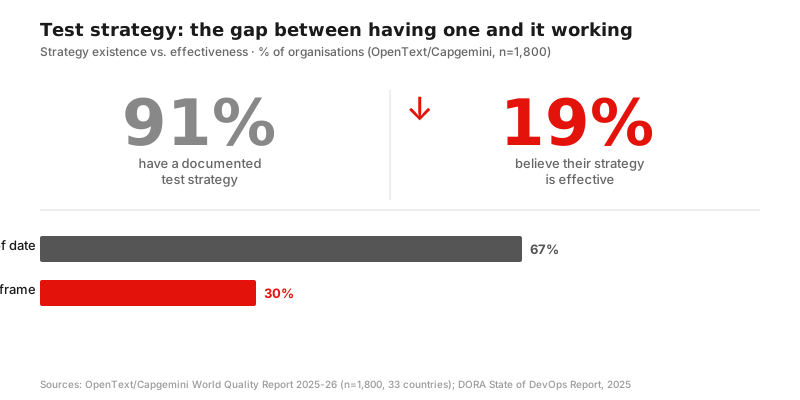
 Source: OpenText/Capgemini World Quality Report 2025-26 (n=1,800, 33 countries)
Nearly every large technology organisation can produce a test strategy on demand. Almost none can prove that it improves quality. The World Quality Report 2025-2026 surveyed 1,800 technology leaders across 33 countries and found that 91% of organisations had a documented test strategy, but only 19% believed the strategy was effective — down from 23% two years earlier. The modern quality crisis is not a lack of planning. It is the persistence of plans that look rigorous on paper and detach from delivery almost as soon as the ink dries.
That gap matters because strategy is supposed to allocate scarce attention: what to automate first, which risks deserve manual investigation, where environments need investment, and how quickly teams must get feedback. When the strategy is wrong, the organisation does not merely waste a document. It misprices quality itself.
The document problem
The typical test strategy remains a 40-page Confluence artifact written during a project’s optimistic opening weeks, reviewed once by stakeholders who lack the technical context to challenge it, and then quietly abandoned. The World Quality Report found that 67% of test strategies were more than six months out of date. In an industry where deployment frequency increased 35% year-over-year according to DORA’s 2025 report, a strategy written six months ago often describes a system that no longer exists.
This is not chiefly a documentation failure. It is an incentive failure. The person who writes the test strategy is rewarded for its completeness at the moment of approval. Almost nobody is measured on its accuracy two quarters later. So the strategy becomes a compliance artifact — evidence that planning occurred — rather than an operational tool that guides daily testing decisions.
The result is familiar. Teams inherit a document that prescribes contract tests, environment standards and coverage targets with great confidence, then discover that the delivery system cannot support them. A financial-services firm with 1,200 engineers, for example, produced a 60-page strategy in Q1 that mandated complete API contract testing across 47 microservices. By Q3, the teams had fallen back to ad hoc integration testing — not because the mandate was irrational, but because the strategy had been written without the engineers responsible for third-party integrations. Three critical services had no sandbox environment. The strategy had assumed they did.
The automation fantasy
Once strategy becomes theatre, automation is usually where the script turns expensive. Test strategies routinely commit to automation targets that the organisation lacks the infrastructure, skills or budget to achieve. According to the December 2025 LinkedIn article “Your AI Testing Tools Won’t Save You”, the median organisation achieved fewer than 30% of its stated automation goals within planned timeframes. The remaining 70% was deferred, descoped or quietly abandoned.
The pattern is predictable. A strategy mandates 80% automation coverage. The team automates the easy tests first — login flows, simple CRUD operations and happy-path scenarios. These reach 40% coverage quickly, so progress charts look healthy. Then the team reaches integration tests, complex data setups and dependencies on third-party services. Progress stalls. The remaining 40% costs far more than the first 40%, and nobody budgeted for the asymmetry.
Qyrus’s 2026 Guide to Software Testing Cost Estimation describes why. Organisations that forecast automation costs from early pilot results underestimated total programme costs by an average factor of 2.8. Pilot systems tend to have cleaner APIs, narrower workflows and more senior attention than the estate that follows. The hidden costs of maintaining those automation assets compound the problem further — as explored in Test automation’s hidden ledger: costs nobody budgets.
Coverage targets make the mistake worse. A strategy that sets a blanket percentage goal invites teams to optimise the easiest number on the dashboard rather than the riskiest behaviour in production. As argued in Coverage Obsession: The Metric That Ate Quality Engineering, high coverage is often a record of activity rather than evidence that the system is protected where failure would actually hurt.
What a live strategy looks like
The useful alternative is not a larger document. It is a shorter, more explicit operating model. Consider a mid-sized retailer with three critical flows: checkout, returns processing and a monthly finance reconciliation batch. A static strategy tends to assign the same aspiration to all three: automate aggressively, hit a common coverage target, and push for uniform regression depth. A live strategy treats them differently.
Checkout sits on the revenue path, changes weekly and fails publicly. It therefore deserves fast contract tests on every commit, production-like synthetic monitoring, and an explicit feedback target measured in minutes. Returns processing changes less often and has more operational tolerance, so the strategy may justify fewer UI checks and more API-level validation. The monthly reconciliation batch touches finance, not customer interaction; here the higher-value investment may be controlled test data, manual exploratory passes before cut-off, and rollback drills rather than a bloated suite of brittle end-to-end scripts.
That distinction sounds obvious, yet it is exactly what many strategy documents avoid. Uniform policies look fair, but quality economics are not democratic. The system with the highest cost of failure should attract the deepest protection, the fastest feedback and the most senior engineering attention. The system with low change frequency and low business impact should not inherit the same test burden simply because it exists in the same portfolio.
In practice, a live strategy answers four questions for each major flow. What is the business cost of failure? How often does the code change? How quickly must the team know it has broken something? And what is the cheapest mechanism that can provide that signal reliably? Once written that way, strategy stops sounding like doctrine and starts looking like capital allocation.
What the effective minority does differently
The 19% of organisations that reported effective test strategies appear to treat strategy less as doctrine and more as an operating mechanism. Their plans are revised against observed maintenance costs, defect escape rates and feedback delays rather than defended as if revision were failure. That changes both the cadence of decision-making and the quality of the trade-offs.
DORA’s 2025 data reinforces the point: teams that reviewed their test strategy at least quarterly had 40% fewer escaped defects than teams reviewing annually or not at all. The measurement discipline matters more than the measurement ritual. Regular reviews force leaders to decide whether a target still reflects production risk, whether a test suite is yielding signal fast enough, and whether infrastructure bottlenecks should be funded as platform work rather than absorbed by project teams.
The strongest teams also make ownership explicit. If a strategy says contract testing matters, somebody owns the provider stubs, schema governance and environment fidelity required to make contract testing real. If it says feedback must arrive in under ten minutes, somebody owns CI parallelisation, test selection and the removal of redundant checks. The test strategy stops being a wish list and becomes a set of funded promises.
That, in turn, produces a more realistic strategy. Effective teams measure outcomes rather than activities: escaped defects, mean time to feedback and the ratio of test maintenance to feature development hours. They fund environments and test data as shared capabilities, not optional extras. And they are willing to admit, quarterly, that the previous strategy was partly wrong.
The organisations that test well are therefore not the ones with the thickest strategy documents. They are the ones with the shortest distance between evidence and revision. A test strategy earns its value only when it is cheap to challenge, cheap to update and tightly connected to the economics of delivery. Most quality plans fail because they are written as declarations of intent. The useful ones survive because they are run as feedback systems.
References
- OpenText & Capgemini, “World Quality Report 2025-2026”, OpenText, July 2025
- DORA, “State of DevOps Report 2025”, DORA/Google Cloud, September 2025
- LinkedIn, “Your AI Testing Tools Won’t Save You: The Real Problem”, December 2025
- Qyrus, “The 2026 Guide to Software Testing Cost Estimation”, Qyrus, November 2025






Discussion