
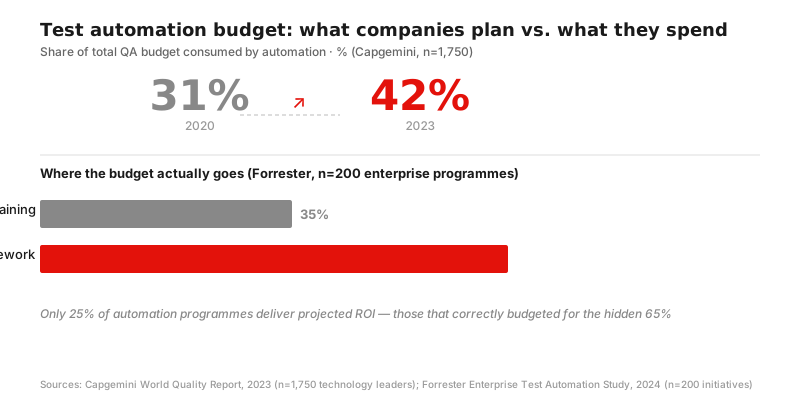
Capgemini’s World Quality Report surveyed 1,750 technology leaders in 2023 and found that test automation consumed 42% of their total QA budgets — up from 31% in 2020. The increase was not driven by expanding test suites. It was driven by the maintenance, infrastructure, and specialist labour required to keep existing automation running. Organisations are spending more on automation each year and, by their own assessment, getting proportionally less in return.
 Source: Capgemini World Quality Report, 2023; Forrester Enterprise Test Automation Study, 2024
The three costs nobody forecasts
The visible cost of test automation — tool licences, initial script development, basic training — typically accounts for 30-40% of the total programme expense, according to Forrester’s 2024 analysis of 200 enterprise test automation initiatives. The remaining 60-70% falls into three categories that rarely appear in the original business case.
% of total programme cost · Forrester 2024
35%
40%
15%
10%
Visible costs: 35% · Hidden costs: 65%
Source: Forrester, Enterprise Test Automation Cost Analysis, 2024; Capgemini, World Quality Report, 2023
Infrastructure is the first. Automated tests require environments that mirror production with sufficient fidelity to produce meaningful results. At a major European retailer that Deloitte studied, the cost of maintaining six parallel test environments exceeded the annual licence fee for the automation platform by a factor of three. Each environment required dedicated infrastructure, synthetic data management, and integration stubs for third-party services — costs that the automation business case had classified as “existing infrastructure” and excluded.
Maintenance is the second. The World Quality Report found that organisations spend 40-60% of their total automation effort on maintaining existing tests rather than creating new ones. Every UI redesign, API version change, and infrastructure migration triggers a cascade of test updates. At Walmart, the engineering team reported that a single major UI refresh in 2023 required updates to 12,000 automated test cases — a three-month effort that produced no new test coverage.
The third cost is the hardest to quantify: opportunity cost. Engineers maintaining brittle test suites are engineers not writing new tests for emerging features, not conducting exploratory testing, and not investigating the test failures that reveal genuine production risks. Microsoft’s internal engineering productivity research found that teams with high test maintenance burdens discovered 34% fewer production defects through testing than teams with well-maintained, stable suites.
The speed trap
The most seductive promise of test automation — faster feedback — creates its own cost dynamic. Organisations that achieve fast test execution discover that speed amplifies the cost of unreliability. A test suite that runs in 10 minutes and fails intermittently 5% of the time generates 7 false alarms per day in a typical CI/CD pipeline. Each false alarm interrupts a developer, triggers an investigation, and erodes confidence in the test suite’s signal. Google’s testing research team calculated that flaky tests cost the company $2.6 million annually in developer time devoted to investigating false failures.
The response to flakiness is typically more automation — retry mechanisms, quarantine systems, stability monitors — each adding complexity and cost to a system whose primary justification was simplicity and speed. The test automation programme becomes, in effect, a product that requires its own engineering team to maintain.
The organisations that break the cycle
Netflix’s test engineering team publishes its internal metrics with unusual candour. The company’s approach inverts the conventional automation strategy: instead of maximising the number of automated tests, Netflix optimises for the signal-to-noise ratio of its test suite. Tests that fail intermittently are deleted, not quarantined. Tests that have not detected a genuine defect in six months are reviewed for retirement. The result is a smaller, faster, more reliable suite that costs less to maintain and catches more real defects per test hour.
The lesson is counterintuitive but consistent across organisations that control automation costs effectively: the goal is not more tests. It is better tests — fewer scripts that each deliver higher confidence, maintained by engineers who understand both the test and the system it validates. The most expensive test in any suite is the one that passes every day and has never found a bug.
Understanding these dynamics before committing to an automation programme makes the difference between a realistic business case and a promising-looking failure. The economics of test automation — when measured accurately — can still justify investment, as detailed analysis of enterprise ROI trajectories shows: median returns reach 143%, but only after 23 months, and only for programmes that correctly forecast the full cost base from the outset. The organisations that budget for infrastructure, maintenance, and the talent required to manage complexity are the ones that eventually reach those returns. Those that budget only for tooling discover the hidden ledger when it is too late to adjust.
References
- Capgemini, “World Quality Report 2023-24”, Capgemini, 2023
- Forrester, “Enterprise Test Automation Cost Analysis”, Forrester Research, 2024
- Deloitte, “Testing Infrastructure Costs in Retail Technology”, Deloitte, 2024
- Google, “The Cost of Test Flakiness at Scale”, Google Research, 2023
- Netflix, “Testing at Netflix: Signal Over Coverage”, Netflix Tech Blog, 2023





Discussion