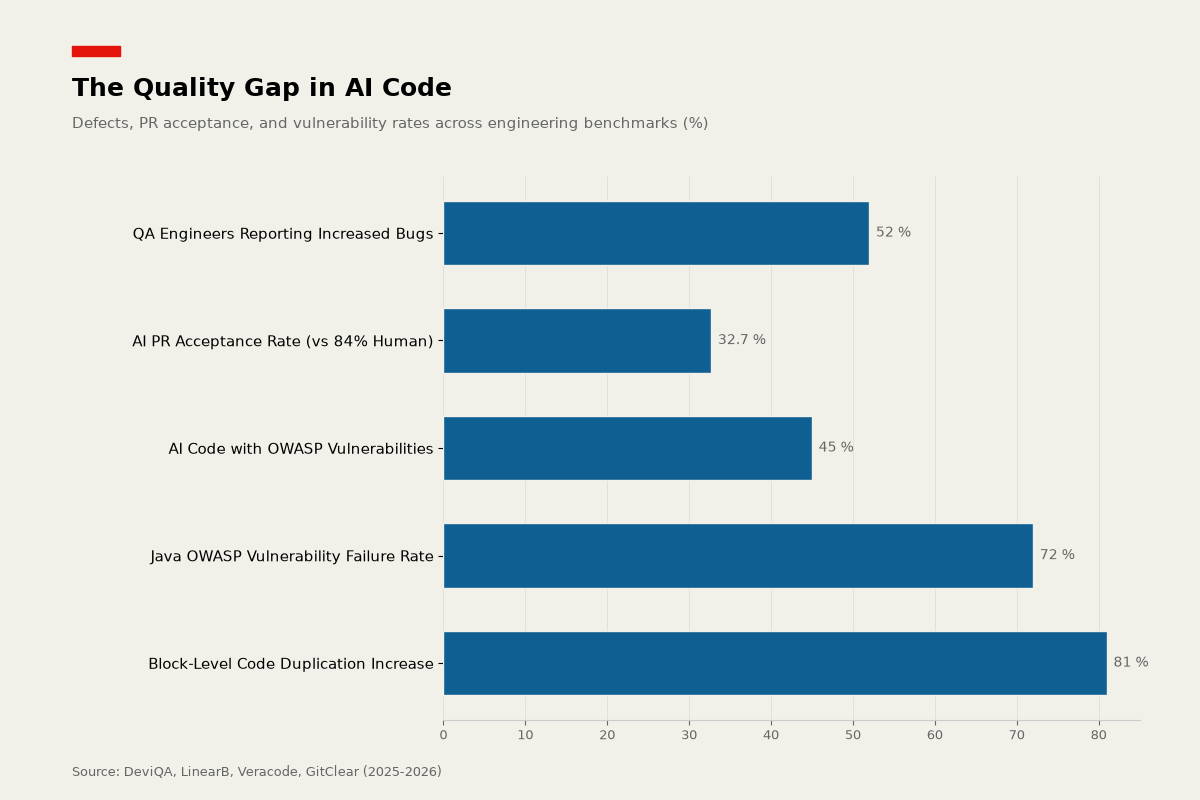
Speed, in software engineering, has always been purchased on credit. AI coding agents have simply raised the credit limit to a genuinely alarming degree, and nowhere more acutely than in microservices architectures, where a single broken contract between services cascades in ways no unit test catches before production. Agentic development, as currently practised, is systematically eroding the assumptions on which microservices test strategy rests. That is the argument. The evidence for it is now quantified, cross-industry, and depressingly consistent. A survey of 300 QA engineers by DeviQA found that 52% reported increased bug volume since adopting AI-generated code, and not one respondent awarded AI output a perfect trust score; the mean was 3.16 out of 5. CodeRabbit’s December 2025 analysis of 470 real-world GitHub pull requests sharpens the picture further: AI-authored code contained 1.7 times more issues than human-authored submissions, logic and correctness errors ran 75% more prevalent, and security vulnerabilities ran as much as 2.74 times higher. The most common defect classes (logical errors, cited by 58% of DeviQA’s respondents, and unhandled edge cases, cited by 52%) are precisely the failure modes most damaging in loosely-coupled architectures where each service boundary is a trust assumption in disguise. One caveat belongs up front: every dataset in this piece is vendor telemetry, gathered by firms that sell into the problem they measure, and GitClear itself cautions against causal readings of its trend lines. The findings replicate across five independent vendors with different incentives, which is why they are worth taking seriously; it is corroboration, not proof.
The Review Queue That Cannot Clear
The problem compounds at the integration layer. LinearB’s 2026 Software Engineering Benchmarks Report, drawn from 8.1 million pull requests across 4,800 engineering teams in 42 countries, found that AI-assisted teams merged 98% more pull requests in 2026. At first glance, that reads as productivity. Read further and the picture inverts: review time rose 91%, AI-assisted pull requests waited 4.6 times longer for a reviewer to pick them up than human-authored submissions, and fully agentic pull requests waited 5.3 times longer, 1,055 minutes against 201. Acceptance rates diverged with equal drama: 32.7% for AI-generated code versus 84.4% for human-authored work. In a monolith, a slow review queue is a scheduling nuisance. In a microservices environment, where each service publishes and consumes contracts that other teams build against, a pickup lag of five times and more is a structural hazard. A breaking change to a payment service’s API surface sits unreviewed for the better part of eighteen hours while dependent services continue to integrate against a contract that no longer holds. The window between a broken contract and its detection, already a design challenge in distributed systems, widens by exactly the factor that makes agentic development feel so productive. That perversity is not incidental. It is what happens when the generation rate of plausible code outpaces the human capacity to evaluate it.
Duplication’s Compounding Tax
Beneath the review bottleneck lies a structural problem that is slower but ultimately more corrosive. GitClear’s 2026 analysis of 623 million changed lines of code found that block-level code duplication climbed 81% between 2023 and 2026, reaching 73 duplicate blocks per million lines, while refactored code, the structural work that prevents independent services from calcifying into hidden dependency tangles, collapsed from 21% of all changes in 2022 to just 3.8% today. Copy-paste now outpaces refactoring five to one. In microservices architectures, duplication carries an operational cost. When a validation routine is copied between five services rather than extracted into a shared library, each service owns its own drift. A security patch applied to one copy must be applied to the other four, and frequently is not. A business-rule change propagates to three of the five before someone ships under a deadline. DeviQA’s finding that unhandled edge cases are the second most common AI defect class is not a coincidence: agents that autocomplete by analogy from surrounding context copy the logic and, invisibly, copy the gaps. Each duplicated block is a deferred renegotiation with the future, and in a microservices fleet, the fleet collects the debt.
OWASP at the Service Boundary
Microservices give security failures an ideal propagation medium. Veracode’s 2025 study of more than 100 large language models across 80 security-sensitive coding tasks found that 45% of AI-generated code samples contained OWASP Top 10 vulnerabilities, with Java faring worst at a 72% failure rate. More troubling still, the Cloud Security Alliance’s research note on that study observed that the pass rate remained flat at approximately 55% through March 2026 despite successive model releases. Scaling the model does not fix it. Service boundaries are where authentication tokens are validated, where data crosses trust domains, where injection attacks find their foothold. When an AI agent writes the authentication middleware for a new microservice and that middleware fails a basic OWASP check, the failure is invisible until an attacker or a penetration tester surfaces it. Most teams discover security vulnerabilities by the latter route; the window between deployment and discovery is typically long enough to matter. A contract test suite that verifies business logic whilst ignoring security contracts at the service boundary is, at this juncture, a liability dressed as assurance.
Specification as the Artefact
The methodological corrective gaining traction among teams grappling with these failures is spec-driven development. The honest version of the evidence runs through METR’s pair of studies. Its 2025 randomized trial of 16 professional developers across 246 real-world tasks found developers using AI agents felt 20% faster while measuring 19% slower. In February 2026 METR revised the picture: after correcting a selection effect, a larger cohort of 57 developers across 800 plus tasks showed a statistically indistinguishable 4% slowdown, and METR now judges that current tools likely help. What survived the revision, in both cohorts, is the perception gap: developers consistently believe they are faster than the clock says. That gap is the velocity illusion, and it is why the LinearB queue data matters more than any single speed estimate. Generation feels free; the 4.6 times pickup lag, the 32.7% acceptance rate, and the duplication tax are where the bill arrives. Agents generate plausible code (code that compiles, that passes the unit tests in the same repository, that reads like software) but that fails when integrated against a specification it was never given. Spec-driven development inverts the workflow by making the specification the artefact the agent must satisfy, rather than the output it produces. A consumer-driven contract test, written before the service is built, gives the agent a target precise enough to be falsifiable. An OpenAPI schema committed to the repository before the first line of implementation code constrains the agent to the contract rather than permitting it to invent one. The prediction, then: when an agent operates inside a well-formed specification envelope, the 1.7-times bug rate narrows; when it operates outside one, the 4.6-times pickup lag and 32.7% acceptance rate are roughly what physics predicts.
Two findings would weaken this argument. If LinearB’s 2027 benchmarks show AI PR acceptance converging toward the human 84% while review lag falls, the queue problem is transitional tooling friction, not structure. And if Veracode’s tracked security pass rate breaks meaningfully above its 55% band on the next model generation, the plateau was parametric after all. Neither has happened yet; both are checkable within a year. The choice is not between speed and quality. Teams that treat the specification, not the generated code, as the primary investment are discovering that the two are not in tension; they were always the same thing, and the agents simply made the elision expensive enough to notice. Software that ships faster than anyone can reason about it does not arrive at production: it escapes there.
The Monday version of this is checkable. Pick one service pair. Commit the consumer-driven contract and the OpenAPI schema to the repository before the agent writes a line, wire the contract test into the pipeline as a merge gate, and measure two numbers over the next quarter: first-review acceptance rate on AI-authored PRs against that boundary, and contract-related defects escaping to integration. If the first does not rise and the second does not fall, the specification envelope is not working and you should know within twelve weeks.
As the chart below illustrates, quality metrics, pull-request acceptance rates, and security vulnerability baselines diverge sharply when AI agents operate without strict specification boundaries.
References
-
DeviQA. State of AI-Generated Code 2026: The QA and Testing Gap. Survey of 300 QA engineers, SDETs, and test leads. https://www.deviqa.com/blog/state-of-ai-generated-code-2026-the-qa-and-testing-gap/
-
CodeRabbit. State of AI vs Human Code Generation (December 2025). Analysis of 470 GitHub pull requests (320 AI-co-authored, 150 human-only). https://www.coderabbit.ai/blog/state-of-ai-vs-human-code-generation-report
-
LinearB. 2026 Software Engineering Benchmarks Report. 8.1 million pull requests, 4,800 engineering teams across 42 countries. https://linearb.io/resources/software-engineering-benchmarks-report
-
GitClear. The Maintainability Gap: 2026 AI Code Quality Research. 623 million changed lines, 2023 to 2026. https://www.gitclear.com/the_ai_code_quality_maintainability_gap
-
Veracode (2025), as reported in Cloud Security Alliance Research Note. AI-Generated Code Vulnerability Surge 2026. Study of 100+ large language models across 80 security-sensitive coding tasks. https://labs.cloudsecurityalliance.org/research/csa-research-note-ai-generated-code-vulnerability-surge-2026/
-
METR. Measuring the Impact of Early-2025 AI on Experienced Open-Source Developer Productivity (July 2025), arXiv:2507.09089; and METR, We are Changing our Developer Productivity Experiment Design (February 2026). https://metr.org/blog/2026-02-24-uplift-update/




Discussion