AI quality testing tools can halve software testing time, according to the Capgemini Research Institute. Yet despite the promise of rapid and efficient software validation, only 15% of companies have fully embraced AI within their quality testing processes. This considerable gap between potential and current adoption underscores the hesitancy prevailing among many in the tech industry.
The Rise of AI in Quality Testing
AI’s ability to automate and enhance the testing process has driven substantial interest in its application within the software industry. The AI quality testing tools market was valued at $1.8 billion in 2024, highlighting its economic significance. The potential benefits are manifold: reduced testing times, improved accuracy, and better resource allocation. Indeed, MarketsandMarkets projects that AI automation in quality testing will grow at a compound annual growth rate (CAGR) of 15.5% from 2024 to 2028, suggesting an accelerating interest in this technology.
Moreover, advances such as camera-controlled video diffusion models and generalist robotic agents are poised to further enhance AI’s capabilities in quality testing. For example, recent developments in video-camera alignment could facilitate more precise video testing, while improved robotic models might bridge the gap in real-world application testing.
Disparity Between Potential and Adoption
Despite the evident advantages of AI testing tools, their adoption remains surprisingly limited. Only a small fraction, 15%, of companies have fully integrated AI into their quality assurance processes. The hesitation can be attributed to several factors, including the high initial costs, the complexity of integrating AI into existing systems, and a lack of in-house expertise to manage these advanced systems.
This gap between the potential of AI in testing and its actual implementation suggests a cautious approach within the industry. Companies may be waiting for further validation of AI’s capabilities or seeking to offset the financial risks associated with early adoption.
Economic Impact and Industry Implications
AI’s influence on the software testing landscape is profound, offering both cost savings and efficiency gains. An anticipated 50% reduction in testing time can significantly influence product development cycles, potentially leading to quicker time-to-market for innovations. The economic ramifications of a more rapid development cycle are substantial; organisations can benefit from improved competitiveness and responsiveness to market demands.
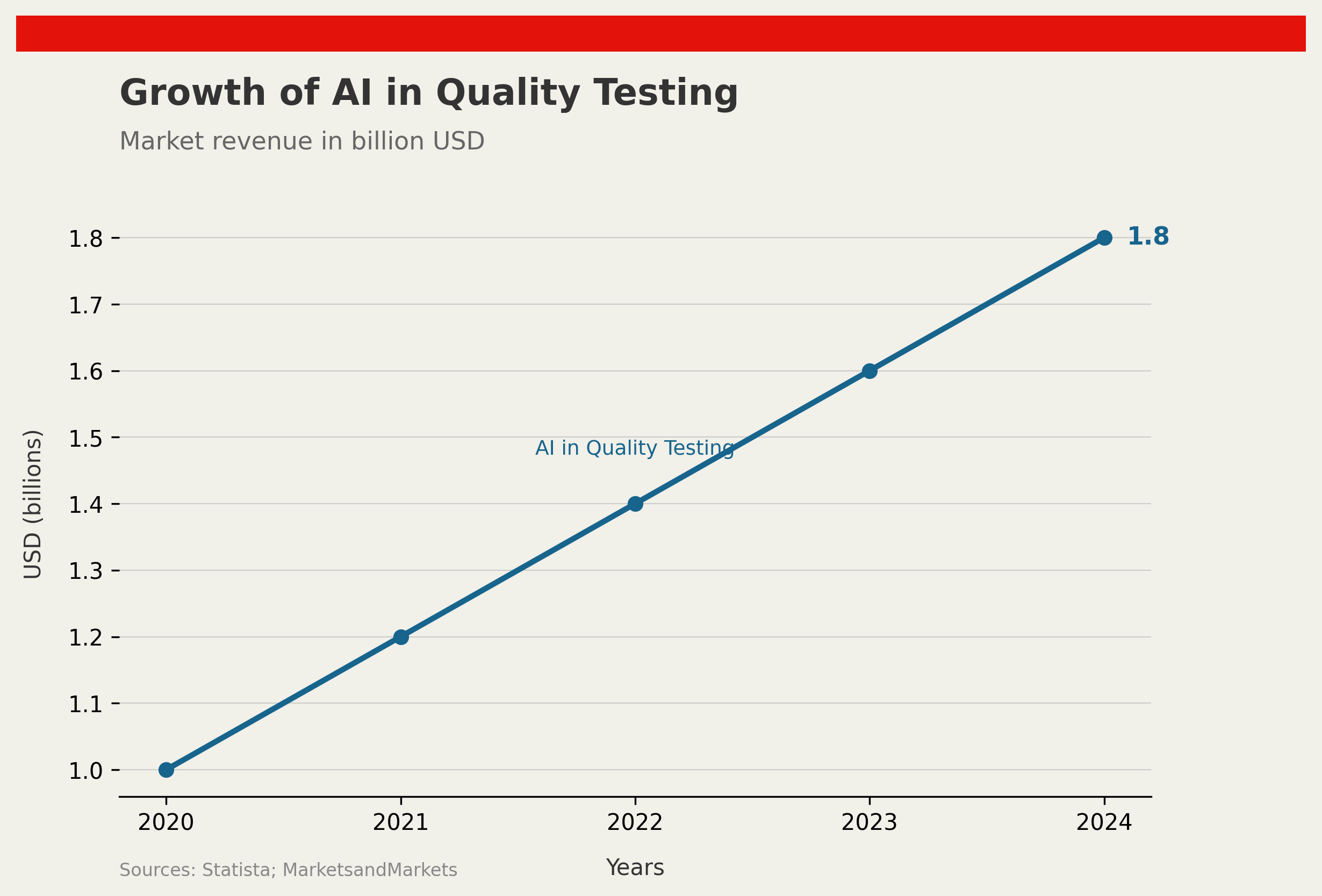
As the chart shows, the market revenue for AI in quality testing has steadily increased from $1.0 billion in 2020 to $1.8 billion in 2024, illustrating a robust upward trend. This growth reflects a broader industry trend towards automation, driven by a need to manage the increasing complexity and scale of modern software systems effectively.
The Path Forward
The future of AI in quality testing hinges on broader adoption and integration. Key to this advancement is the resolution of integration challenges and the development of training programs to equip professionals with the necessary skills to harness AI tools effectively. Additionally, as technological advances continue at pace, it is crucial for organisations to remain agile, adapting to new tools and methodologies that can offer competitive advantages.
AI quality testing is on track to redefine the parameters of software testing, but only if the tools are widely adopted and fully integrated into existing processes. For the promise of reduced testing times and improved quality to be fully realised, companies must invest not just in technology but in the infrastructure and expertise needed to support and sustain innovation.
References
- Capgemini Research Institute, “AI in Software Testing,” Capgemini, 2024.
- MarketsandMarkets, “AI in Software Testing Market Report”, MarketsandMarkets, 2024.
- World Quality Report 2024-2025, “World Quality Report”, Capgemini, 2024.
- Statista, “AI Testing Tools Market Size”, Statista, 2024.