
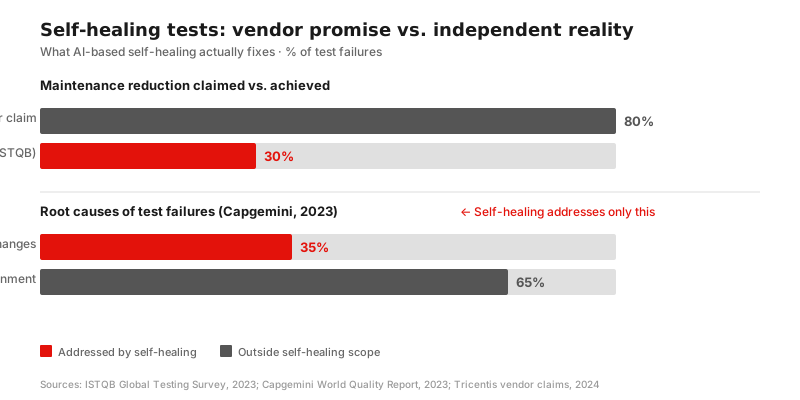
 Source: ISTQB Global Testing Survey, 2023; Capgemini World Quality Report, 2023
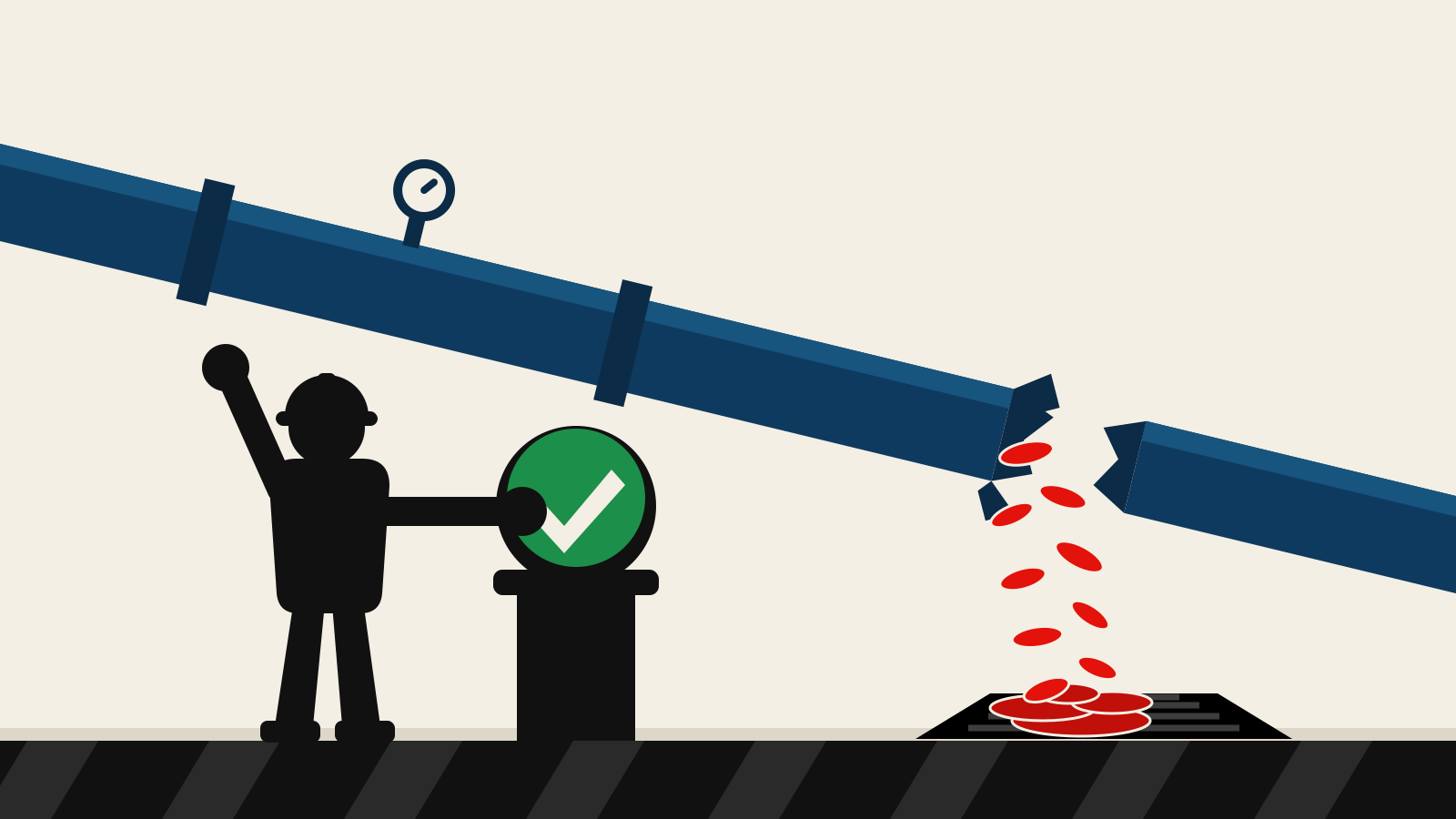
Tricentis, the testing platform company, claims its self-healing technology reduces test maintenance by 80%. Mabl advertises “zero-maintenance testing.” Functionize promises tests that “fix themselves.” These are extraordinary claims — and the data, when it arrives from independent sources rather than vendor marketing, tells a more complicated story. ISTQB’s 2023 global survey found that 85% of organisations using self-healing tests reported some decrease in maintenance time. But only 30% achieved what they had been promised: meaningful autonomy from manual test updates.
The healing that isn’t
Self-healing tests work by detecting when a user interface element has changed — a button moved, a class name updated, an ID attribute renamed — and automatically adjusting the test selector to match the new state. The concept is sound, and for simple locator changes it works reliably. The problem is that simple locator changes account for a minority of real-world test failures.
Capgemini’s World Quality Report 2023 documented the maintenance effort that self-healing tools actually address. Of the test failures that QA teams investigated, 35% stemmed from locator changes — the kind that self-healing handles well. The remaining 65% involved functional changes, data-dependent failures, timing issues, and environmental instability. Self-healing has nothing to say about a test that fails because the API contract changed, or because the test database was not properly reset between runs.
Google’s testing infrastructure team, which maintains one of the largest automated test suites in the world, published research in 2023 on test flakiness at scale. The team found that fewer than 20% of flaky test failures could be addressed by locator-based self-healing. The rest required human diagnosis — understanding whether the failure represented a genuine regression, a test environment problem, or a timing race condition. Self-healing tools, confronted with these failures, either ignored them or made incorrect adjustments that masked real defects.
The maintenance shell game
Organisations that adopt self-healing tools often experience a genuine reduction in one category of maintenance work — the tedious, repetitive business of updating selectors after UI redesigns. This reduction is real and valuable. What frequently goes unreported is the new maintenance burden that self-healing introduces: monitoring the healer’s decisions, auditing its corrections, and debugging the subtle failures that occur when the tool confidently adjusts a test in a way that changes its intent.
At a North American financial services company studied by Forrester in its 2023 Total Economic Impact analysis of testing tools, self-healing reduced locator-related maintenance by 45% while increasing the time spent reviewing automated corrections by 30%. The net maintenance reduction was 15% — useful, but a fraction of the 60-80% figures in vendor marketing.
The honest case
Self-healing tests are a genuine incremental improvement in test automation, not a transformative technology. They belong in the same category as auto-formatting tools and linting — features that eliminate a specific category of tedium without changing the fundamental nature of the work. The organisations extracting the most value from self-healing are those that deploy it with modest expectations, measuring the actual maintenance hours saved rather than the percentage the vendor promised.
TestGuild’s State of Testing 2024 survey reinforced this point: organisations that tracked maintenance hours before and after self-healing adoption reported a median reduction of 18% — useful, but well below vendor projections. Crucially, the teams that achieved the highest reductions were those that had already invested in stable test architectures, including page object models and data isolation patterns, before introducing self-healing. The tool amplified existing discipline; it did not substitute for it.
Gartner predicted that 70% of enterprises would incorporate self-healing tests into DevOps by 2025. That adoption target will likely be met in numerical terms, if not in outcome terms. The tools will be widely installed. The maintenance burdens they were supposed to eliminate will persist, in modified form, alongside them.
The test suites that truly heal themselves remain a research aspiration. Today’s self-healing tools are, more accurately, self-adjusting — and the distinction between healing and adjusting is precisely the gap between the marketing and the reality.
This pattern — where AI tooling delivers incremental gains on narrow tasks while leaving the broader maintenance problem largely intact — is not unique to self-healing tests. The same dynamic applies to AI test generation tools, where vendor claims of 60-80% maintenance reduction consistently outpace what independent studies find in practice. According to the Capgemini 2025 Quality Engineering Report, organisations that had adopted both self-healing and AI generation together reported a combined maintenance reduction of 28% — useful, but a fraction of the combined 120-160% reduction implied by vendors marketing each tool independently. The tools are complements to skilled testing teams, not replacements for them.
References
- ISTQB, “Global Testing Practices Survey 2023”, ISTQB, 2023
- Capgemini, “World Quality Report 2023-24”, Capgemini, 2023
- Google, “Test Flakiness at Scale: Root Causes and Remediation”, Google Research, 2023
- Forrester, “Total Economic Impact of AI-Powered Testing”, Forrester Research, 2023
- TestGuild, “State of Testing 2024”, TestGuild, 2024


Discussion