
Global security debt is projected to cost organisations an average of $9 million annually by 2026 due to unpatched vulnerabilities, according to a report by Cybersecurity Ventures. As cyber threats grow in complexity and frequency, the economic implications of failing to patch known vulnerabilities have become undeniably significant. Despite their knowledge of the financial risks, many organisations remain vulnerable, highlighting a critical issue: the escalating costs associated with poor vulnerability management and the struggle to implement effective security strategies.
Rising Costs of Security Breaches
Unpatched vulnerabilities are a ticking time bomb, accounting for up to 60% of cyber breaches. Even as the average cost of a data breach reached $4.35 million in 2025, the urgency of addressing these vulnerabilities has not been matched by action within many companies. Analysts from the IBM Cost of a Data Breach Report affirm that these breaches are not merely costly incidents but symptomatic of deeper systemic issues within organisations’ approaches to cybersecurity.
Companies that delay patching critical vulnerabilities often see their potential breach costs rise by as much as 50%, according to FTI Consulting. This daunting increase demonstrates not only the latent financial risks but also the reactive approach many organisations have towards cybersecurity. Rather than proactively managing vulnerabilities, businesses frequently find themselves in a cycle of firefighting—addressing issues only after they escalate into breaches.
Security Debt Management
The increase in security debt management costs over the past few years clearly illustrates the growing fiscal burden of unaddressed cybersecurity weaknesses. As evidenced by the data, there has been a significant rise in these costs, moving from $5 million in 2024 to a projected $9 million by 2026.
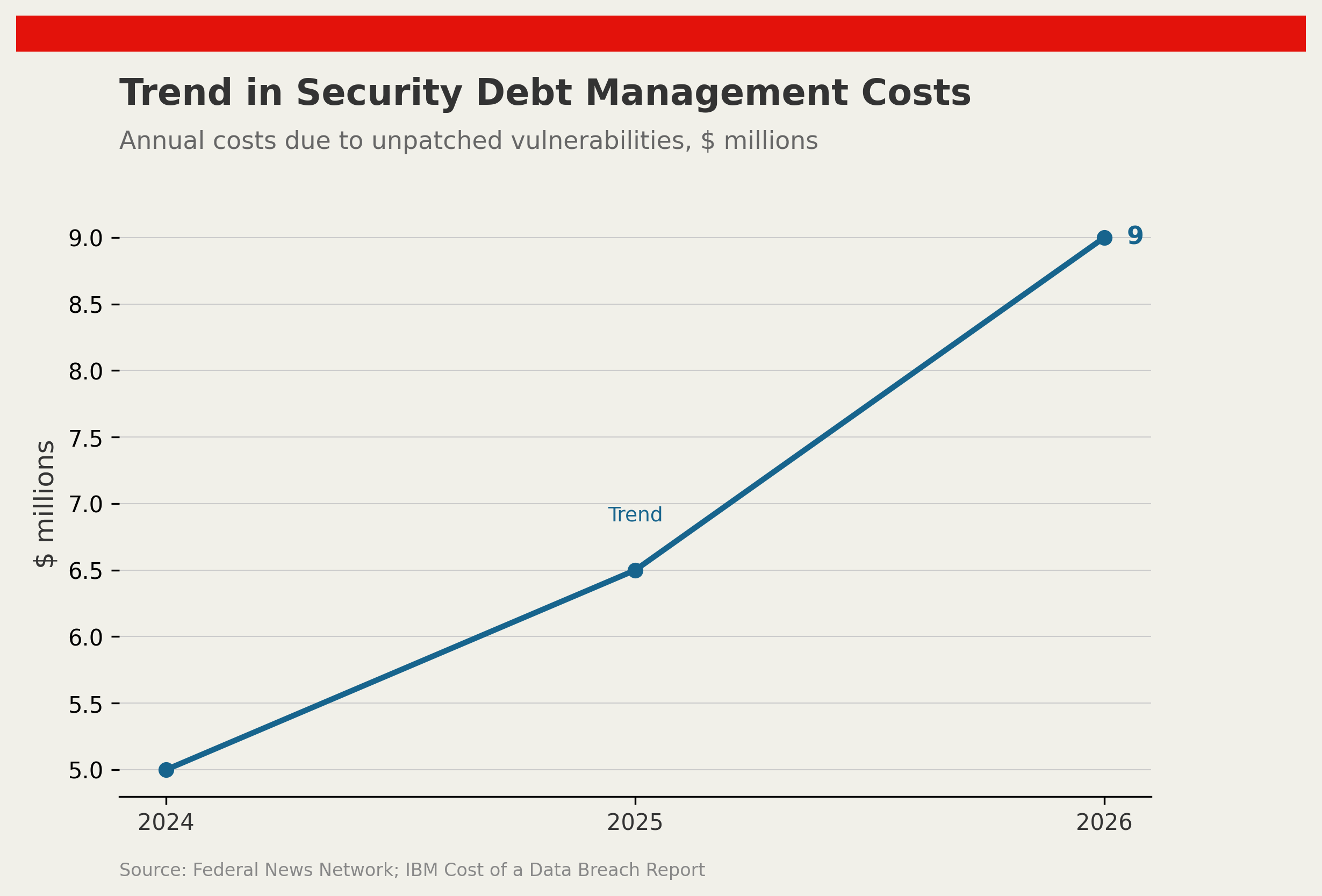
As the chart shows, this steady rise reflects not only the increasing frequency of cyber threats but also the growing necessity for organisations to invest more significantly in security measures aimed at reducing their security debt.
Challenges in Addressing Security Debt
Addressing security debt is not just a technical challenge but a financial and managerial one. A majority, 60% of Chief Information Security Officers (CISOs), cite budget constraints as the primary hurdle in addressing security debt effectively. The McKinsey Cybersecurity Survey underscores this reality, highlighting how severely limited budgets inhibit the ability to undertake comprehensive vulnerability management.
These constraints lead organisations to spend an average of 10% more on security tools due to inadequate vulnerability management. Essentially, limited budgetary allocations force many companies into a reactive, rather than proactive, stance on cybersecurity, leaving them vulnerable to constant threats and the associated high costs.
The Contrarian Viewpoint
Despite the rising consensus on the escalating costs of security debt, a contrarian viewpoint suggests that strategic investments in security tools and automation could mitigate these projected costs significantly. Proponents argue that, when integrated with robust management practices, such investments could provide a more stable financial impact than expected, allowing organisations to maintain operational efficiency without succumbing to rising cybersecurity costs.
This perspective emphasises the need for organisations to not only focus on immediate vulnerabilities but also implement structured, long-term cybersecurity strategies that make use of emerging technologies, such as AI and machine learning, to predict and prevent threats more efficiently.
Implications for the Future
The financial dynamics of security debt will continue to evolve as organisations strive to keep pace with a rapidly changing cyber threat landscape. The continuous increase in breach costs and security debt management expenses indicates a clear requirement for a strategic overhaul. Organisations must move towards integrating proactive measures into their cybersecurity frameworks.
A real-world example can be seen in the strategic approach taken by major financial institutions. These institutions have incorporated AI-driven threat detection tools, which not only identify potential breaches before they occur but also provide predictive insights that enable more effective resource allocation. These tools represent a forward-thinking strategy that organisations across sectors can emulate to balance their budgets against the need for robust security measures.
Furthermore, organisations adopting comprehensive cyber hygiene practices will be better positioned to manage security debt effectively. By revisiting their security policies and keeping abreast of emerging threat landscapes, they ensure their investments in cybersecurity yield tangible returns. The key lies in transforming cybersecurity from a reactive to a proactive posture, ensuring robust defence mechanisms are in place long before threats materialise.
Ultimately, organisations that strategically invest in advanced security practices and tools today will safeguard their operations and finances against the increasing threat of cyber vulnerabilities tomorrow.
References
- Federal News Network, “Visibility is the Only Way to Fix the Public’s Growing Security Debt”, Federal News Network, 2026, Accessed online.
- IBM Cost of a Data Breach Report, “Data Breach Costs”, IBM, 2025, Accessed online.
- FTI Consulting, “2026: Make-or-Break Year for Economy”, FTI Consulting, 2026, Accessed online.
- McKinsey Cybersecurity Survey, “Cybersecurity 2026”, McKinsey, 2026, Accessed online.


Discussion